Struggling with sluggish flight performance after upgrading your custom build? Heavy power sources often ruin the very agility that makes flying FPV thrilling, while undersized packs leave commercial rigs grounded before the mission is complete. Choosing the precise 6S drone battery capacity solves this dilemma entirely. It delicately balances physical mass, motor thrust, and KV ratings to engineer the perfect flight experience.
The 6S configuration, delivering a nominal 22.2 volts, has rapidly become the gold standard across the UAV industry. Whether you are tuning an agile 5-inch quadcopter to dive through abandoned infrastructure or configuring a heavy-lift commercial rig for topographical mapping, this higher voltage setup provides the necessary raw power. Selecting the ideal milliamp-hour rating is not simply about grabbing the largest pack available. It requires a strategic, mathematical approach to ensure your aircraft remains highly responsive. In this comprehensive technical guide, you will learn the exact capacity formulas and discover expert tips to optimize your power system.
Key Takeaways for System Design
Consideration
Core Engineering Principle
Capacity vs. Weight
Larger capacity increases flight time strictly up to an aerodynamic threshold. Excess weight causes severe diminishing returns and spikes motor temperatures.
Application Matching
A 5-inch freestyle drone requires 1000mAh to 1300mAh for agility. Commercial multirotors demand massive capacities exceeding 20,000mAh.
Voltage Equivalence
Upgrading from a 4S to a 6S powertrain requires a roughly 33 percent reduction in mAh to maintain identical physical weight and total energy payload.
BMS Integration
High-capacity enterprise configurations rely on active management systems to prevent deep discharging and ensure individual cell stability.
Understanding the Basics of a 6S Power System
To make an informed decision regarding capacity, you must first understand the fundamental architecture of a 6S energy reservoir. The term 6S refers to the internal wiring configuration of the pack, indicating that six individual lithium cells are connected in series. Because a standard lithium-ion or lithium-polymer cell has a nominal voltage of 3.7 volts, multiplying this by six yields a system voltage of 22.2V. When fully charged, the entire pack reaches a peak of 25.2V.
This elevated voltage explains why the 6S configuration dominates modern drone engineering. According to Ohm's law and basic power equations, delivering a specific amount of wattage at a higher voltage requires proportionally less electrical current. Lower amp draw significantly reduces the thermal load generated by electronic speed controllers, stator windings, and XT60 connectors. Consequently, the power delivery system experiences far less voltage sag under heavy throttle, resulting in a highly consistent thrust output from takeoff to landing.
When evaluating these power sources, system designers must clearly distinguish between capacity measured in milliamp-hours and total energy measured in Watt-hours. Capacity simply indicates the volume of electrical charge the pack holds. Because a 6S setup operates at a much higher voltage than older 4S systems, comparing their mAh ratings directly is highly misleading. Watt-hours provide the truest empirical measure of the total energy payload your aircraft carries.
The Golden Rule: Managing the Thrust-to-Weight Ratio
Selecting the ideal capacity is fundamentally an exercise in physics and aerodynamics. Every additional gram of energy storage added to the airframe requires the motors to generate more thrust simply to maintain a stable hover. This increased mechanical workload draws more current, which ironically consumes the very capacity you just added to the aircraft.
This dynamic creates a strict bell curve of diminishing returns. Up to a certain threshold, increasing the mAh rating will yield longer flight times. Once the battery weight pushes the drone's hover throttle past optimal efficiency—typically above 25 percent throttle for high-performance builds—the excess energy spent carrying the heavy payload completely negates the extra capacity. The airframe becomes incredibly sluggish, motor temperatures spike dangerously high, and actual flight times will decrease.
To calculate the maximum viable payload, experienced builders rely heavily on the thrust-to-weight ratio. The standard engineering rule dictates that the total weight of the drone, battery included, should never exceed 50 percent of the maximum combined thrust generated by the motors. Adhering to these strict ratios ensures that the selected capacity enhances endurance without destroying aerodynamic stability.
Sizing the Drone Battery by Specific Application
Capacity selection cannot be generalized across the industry. It is strictly dictated by the drone's intended operational profile. The optimal rating for a nimble racing quadcopter will severely underperform on a commercial mapping rig.
FPV Freestyle and Racing Drones
When executing high-G pullouts in a 5-inch freestyle build, excess mass creates fatal momentum. If your energy reservoir is excessively heavy, inertia will drag the quadcopter straight into the ground during sharp directional changes. For standard 5-inch freestyle drones, explosive acceleration is paramount. The empirical sweet spot for these builds is a capacity strictly between 1000mAh and 1300mAh. A 1050mAh pack keeps the all-up weight incredibly low, allowing for rapid acrobatic recovery. Furthermore, utilizing a High-Performance Drone Battery with a massive discharge rating is critical here, as freestyle flying demands instantaneous bursts of current exceeding 100 amps.
Cinematic and Long-Range Cruisers
Cinematic drones and 7-inch long-range platforms prioritize smooth, stable flight and extended airtime over aggressive acrobatics. Because these drones spend the majority of their flight time in forward motion at a consistent, low throttle position, they can carry heavier payloads with greater efficiency. Capacities for these setups typically range from 1500mAh to 4000mAh. Many long-range operators transition from standard LiPo packs to high-density Lithium-Ion cell configurations to achieve maximum Watt-hours per gram for extended mountain surfing.
Heavy-Lift and Industrial UAV Systems
Commercial drones used for agricultural spraying, LiDAR mapping, and logistics operate on an entirely different scale. These multirotors require massive energy reserves to sustain flight while carrying payloads weighing several kilograms. Capacities in this commercial sector rarely fall below 10,000mAh.
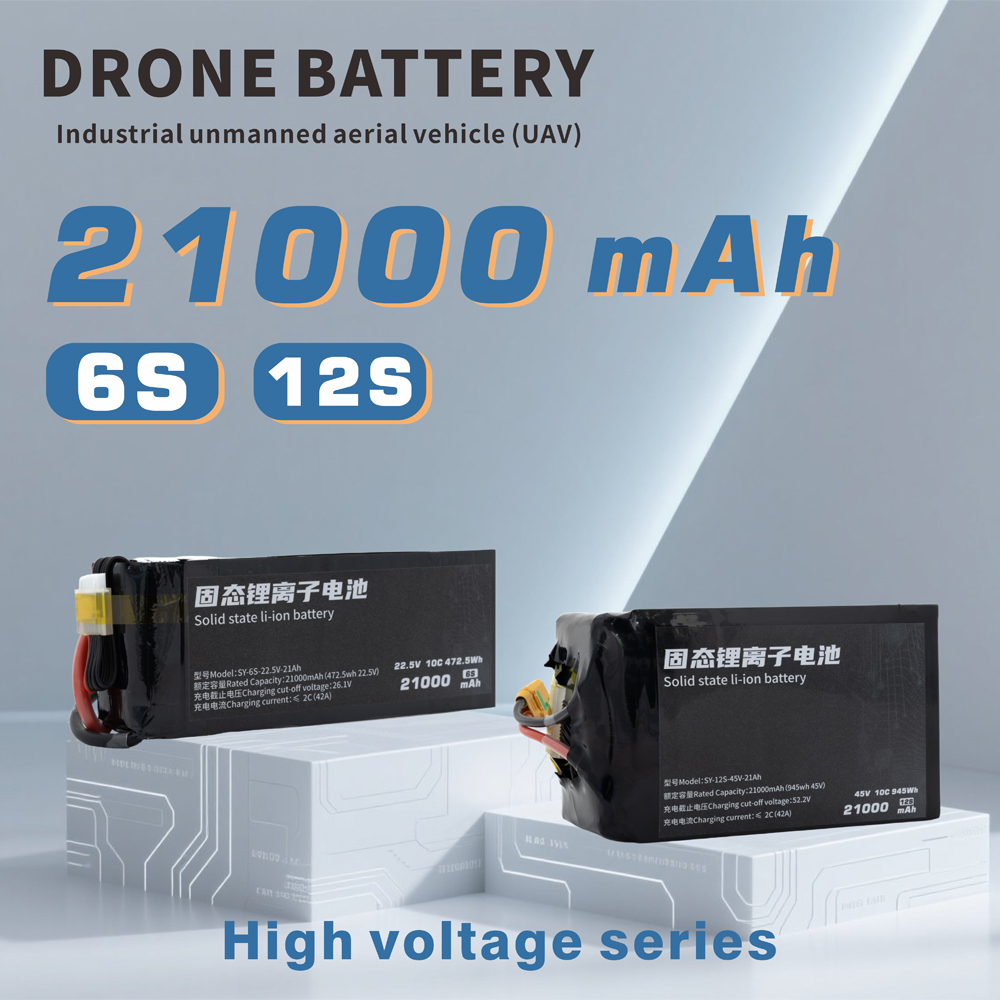
Industry analysts note a massive pivot in commercial UAV energy storage trends. As enterprise missions demand flight times exceeding 45 minutes, operators are hitting the physical energy density limits of standard lithium polymer chemistries. The market is rapidly adopting semi-solid-state technology. This structural shift allows enterprise rigs to carry 30 percent more capacity within the exact same weight footprint. For instance, integrating a 21000mAh Industrial UAV Battery equipped with semi-solid-state chemistry empowers operators to achieve extended autonomous mapping missions without overburdening the aircraft's critical lift limits.
Adjusting Capacity Expectations from 4S to 6S
A frequent point of friction among drone builders transitioning to higher voltage systems is how to adjust their capacity expectations. A common technical question is whether an 850mAh 4S pack provides the same flight time as an 850mAh 6S pack. The objective answer is absolutely not; the 6S battery contains 50 percent more total energy.
To maintain identical flight characteristics, physical weight, and total energy when upgrading your powertrain to 6S, you must reduce the mAh capacity by roughly 33 percent. Consider a standard 4S 1500mAh battery containing roughly 22.2 Watt-hours of energy. A 6S 1000mAh pack contains the exact same amount of total energy and will weigh almost exactly the same. Engineers make the switch to higher voltage not to inflate the mAh number, but to benefit from cooler electronics and significantly more precise throttle resolution.
Matching Your Power Source to Motor KV Ratings
You cannot select a capacity in isolation. The power source's performance is intrinsically linked to the motors it drives, specifically their KV rating. This rating indicates the theoretical RPM the motor will spin per single volt of electricity applied.
Applying 22.2 volts to a motor designed for a lower voltage system will result in disastrously high RPMs. When a propeller is attached, the stator will attempt to reach this impossible speed, drawing massive amounts of current. This extreme amp draw will rapidly deplete even the largest capacity pack in minutes and likely cause an electrical fire. To maintain optimal efficiency, a large High Voltage Drone Battery must be paired with lower KV motors. For a standard 5-inch FPV drone running on six cells, the optimal motor KV typically ranges from 1700KV to 1950KV. This mechanical synergy allows a seemingly small 1050mAh pack to provide excellent flight times.
The Critical Role of Battery Management Systems
As drone applications scale from recreational flying to heavy-lift commercial operations, the physical size and capital cost of the power systems increase significantly. In these high-stakes industrial environments, simply selecting a massive capacity is insufficient. That energy must be actively managed and protected.
A Battery Management System is a sophisticated electronic circuit board integrated directly into the pack that monitors its operational state. Lithium-based chemistries are highly sensitive to voltage extremes. If a single cell within a series is discharged below 3.0V, it sustains irreversible internal chemical damage. Utilizing an Intelligent BMS Drone Battery completely mitigates this risk through active cell balancing and real-time telemetry monitoring. During heavy discharge cycles, the BMS monitors the voltage of all individual cells, preventing deep discharges and ensuring that a high-capacity pack retains its factory-rated mAh over hundreds of commercial flights.
Common Engineering Mistakes When Choosing Capacity
Even with a solid grasp of voltage dynamics, pilots frequently make critical errors during the selection process. These oversights routinely result in sluggish flight performance or drastically reduced hardware lifespans.
One of the most frequent mistakes is focusing entirely on the capacity volume while completely ignoring the discharge rate. If an operator selects a 1300mAh pack featuring only a 30C rating, the maximum continuous amp output is severely bottlenecked. Modern brushless motors can easily draw 120 amps during aggressive maneuvers. A low discharge rating causes severe voltage sag, triggering early low-battery warnings and risking a mid-air power failure.
Another major misstep is falling into the huge battery trap. Novice operators often strap an excessively large 2000mAh pack onto a lightweight 5-inch frame, hoping to double their airtime. Instead, this drastically shifts the center of gravity and increases the moment of inertia. The extra energy provided by the larger capacity is entirely consumed by the mechanical effort required just to keep the heavy rig airborne.
Finally, builders often neglect physical dimensions. A 6S pack contains two more physical cells than its 4S counterpart, making it inherently taller and thicker. Failing to measure the drone's top plate can result in a battery that obstructs spinning propellers or cannot be securely strapped down, leading to dangerous ejections during crashes.
Conclusion
Selecting the right 6S drone battery capacity requires careful mathematical calculations and a thorough understanding of your aircraft's electromechanical limits. You must perfectly balance the physical weight of the airframe, the motor KV ratings, and the specific payload demands of your application.
For agile FPV setups, strictly adhering to the 1000mAh to 1300mAh range ensures optimal acceleration and handling. By contrast, commercial and industrial rigs benefit massively from high-density, semi-solid-state options paired with intelligent management systems. Take the time to calculate your thrust-to-weight ratio accurately, and avoid the trap of simply buying the largest pack available. If you are engineering a professional rig, explore Shengya Power's extensive catalog of industrial-grade, intelligent drone batteries today to find the exact power specifications required to keep your next build flying safely and efficiently.
FAQ
What is the best 6S LiPo capacity for a 5-inch quad?
For a standard 5-inch freestyle quadcopter, the engineering sweet spot for battery capacity is strictly between 1050mAh and 1300mAh. This specific range provides the absolute best balance between flight time and physical mass. A 1050mAh pack keeps the drone incredibly agile for aggressive acrobatic maneuvers. For dedicated closed-circuit drone racing, pilots often drop down to 1000mAh or even 850mAh to shave off every possible gram of weight. Conversely, for light cinematic cruising without heavy acrobatics, a capacity of up to 1500mAh can be utilized effectively.
How do I calculate the maximum battery capacity my drone can lift?
To determine the maximum battery weight your airframe can carry, you must calculate your thrust-to-weight ratio using bench test data from your motor specification sheets. Find the maximum thrust produced by a single motor at 100 percent throttle, then multiply that figure by the total number of motors. As a strict rule of thumb, the total all-up weight of your drone should not exceed 50 percent of your total maximum thrust, providing a minimum 2:1 safety ratio. By subtracting the dry weight of your drone from your maximum allowable total weight, you arrive at the maximum weight allowance for your battery.
Can I use a 6S battery on a drone built for 4S?
Plugging a 6S power source into a drone specifically tuned for 4S is highly dangerous and will likely destroy your hardware instantly. If your Electronic Speed Controllers and flight controller capacitors are not rated for 25.2 volts, the components will short circuit and catch fire. Even if the electronics are rated for higher voltage, applying that much power to high KV motors meant for 4S will cause them to spin at dangerously high RPMs. This draws excessive current that will rapidly burn out the stator windings. You must apply a strict motor output limit in your flight controller software to artificially restrict the voltage if you attempt this conversion.
Why do Industrial UAVs use Semi-Solid State batteries?
Industrial UAVs are designed to carry heavy commercial payloads such as LiDAR sensors or agricultural spraying tanks, requiring massive battery capacities often exceeding 20,000mAh. Traditional Lithium Polymer batteries have a strict energy density limit, making a 20,000mAh LiPo pack exceptionally heavy and large. Semi-Solid State batteries solve this physical limitation by offering a significantly higher energy density through advanced internal chemistry. This technology allows enterprise drones to carry massive capacities in a much lighter, more compact form factor, enabling longer operational flight times without compromising aerodynamic efficiency.
How long does a 6S drone battery last?
Flight times vary drastically based on the aircraft's total weight, motor efficiency, and throttle application. A high-performance 5-inch FPV drone equipped with a 1200mAh 6S pack typically flies for 3 to 6 minutes under heavy, aggressive throttle. Conversely, a highly efficient commercial mapping drone equipped with a 21000mAh semi-solid-state 6S pack can easily sustain stable flight for 40 to 55 minutes depending on wind conditions and payload weight.
At what voltage should I land a 6S LiPo battery?
To maximize chemical lifespan and prevent internal damage, you should land your multirotor when the resting voltage reaches 3.5 volts per cell. For a 6S pack, this means bringing the aircraft down when your on-screen telemetry voltage reads approximately 21.0 volts. Discharging the pack below 19.8 volts under load causes irreversible chemical degradation, which permanently reduces the capacity and increases internal resistance.