Why do heavy-lift drones suddenly lose altitude during aggressive maneuvers? The reality is that many commercial UAVs crash or severely underperform due to weak battery systems unable to handle extreme current spikes. At the heart of a robust aerial platform are Lithium Polymer battery cells, which provide the necessary burst of energy and sustained power for demanding flights. Whether you are engineering a high-speed racing drone, a cinematic camera rig, or a heavy-lift agricultural sprayer, selecting the right energy components is the definitive factor for safety, performance, and flight time. In this comprehensive guide, we will explore core metrics, compare chemistry types, and outline exactly how to select the best power source for your specific aviation application.
Key Takeaways
Unmatched Discharge Rates: High-performance power cells serve as the industry standard for high-power UAVs, delivering massive amounts of current instantly to meet sudden throttle demands.
Energy vs. Weight: These polymer-based units provide an exceptional power-to-weight ratio. This empirical advantage is crucial for maximizing drone payload capacities and maintaining aerial agility.
Chemistry Comparisons: While lithium-ion batteries demonstrate superiority in long-range, low-draw flight scenarios, polymer variations remain the undisputed choice for heavy-lift and high-maneuverability applications where voltage sag must be avoided.
Calculated Selection: Sourcing dependable components requires a methodical approach. Engineers must carefully match the voltage, capacity, and discharge rate to the exact requirements of the drone motors and Electronic Speed Controllers.
Maintenance Matters: Proper charging, storage, and handling protocols are not optional. They are critical requirements for prolonging operational lifespan and preventing catastrophic thermal failures.
Understanding Lithium Polymer Battery Cells in Aviation
The Chemistry Behind the Power
The foundational chemistry of modern drone power relies on the continuous movement of lithium ions between a cathode and an anode. Unlike traditional cylindrical lithium-ion batteries that utilize a liquid electrolyte, lithium polymer technology adapts this system by integrating a solid or gel-like polymer electrolyte. This chemical evolution eliminates the need for heavy, rigid metal casings, allowing manufacturers to utilize a flexible foil pouch-cell format.
For aviation applications, this pouch architecture is highly advantageous. It allows the power unit to be manufactured in various shapes and profiles, seamlessly fitting into the strict spatial constraints of custom drone chassis. Without the burden of a rigid metal cylinder, the overall weight of the power unit drops significantly. This weight reduction directly translates to improved flight efficiency and extended payload capacity.
Why Drones Rely on LiPo Technology
Historically, remote-controlled aircraft relied on Nickel-Metal Hydride or Nickel-Cadmium batteries. Today, commercial drones have entirely transitioned to polymer-based technology due to two primary empirical advantages: superior energy density and the complete absence of the memory effect.
Energy density dictates how much power a battery can store relative to its physical mass. Polymer cells offer a substantially higher energy density than older chemistries, ensuring a drone can carry more stored energy without being grounded by its own weight. Older battery types suffered from a memory effect, where partial discharge cycles would permanently reduce the maximum capacity. Modern polymer cells can be charged regardless of their current discharge state without degrading their total volume, offering the everyday reliability required for commercial and industrial drone operations.
Core Metrics of High-Performance Energy Units
Voltage and Cell Count
Voltage acts as the electrical pressure pushing current to the drone motors. Under standard conditions, the nominal resting voltage varies slightly depending on the specific chemistry, typically sitting around 3.65V, 3.70V, or 3.75V per cell, peaking at 4.2V when fully charged. To meet the aggressive power demands of industrial UAVs, single cells are wired in series. A pack containing four cells in series results in a nominal voltage of 14.8V. Heavy-lift drones often utilize massive 12S or even 14S configurations. Stepping up the voltage allows the motors to produce more mechanical thrust while drawing fewer amps, thereby drastically reducing heat generation across the wiring and speed controllers.
Capacity and Flight Time
Measured in milliampere-hours or ampere-hours, capacity dictates the total electrical fuel volume. While it might seem logical to strap the largest possible battery onto a frame to maximize flight time, aviation physics strictly punishes this approach. There is a steep trade-off between adding larger capacity cells and the diminishing returns caused by the added mass. Eventually, the drone expends more energy lifting the heavy battery than the battery itself provides, resulting in sluggish, inefficient flights.
Discharge Rate for High-Power Needs
The discharge rate indicates the maximum safe continuous current output. To calculate the maximum continuous current draw, multiply the capacity in ampere-hours by the discharge rating. For instance, a 5000 milliampere-hour pack with a 50C rating can safely deliver 250 amps continuously. When engineering agile racing UAVs, utilizing High-Performance LiPo Battery Cells with elevated discharge ratings is non-negotiable. If a drone demands 150 amps during a rapid ascent but the power source is only rated for 100 amps, the voltage will sag drastically. The altitude will drop, and the internal chemistry will overheat, potentially leading to irreversible damage.
Internal Resistance
Internal Resistance, measured in milliohms, represents the natural opposition to current flow within the cell itself. Lower resistance signifies a healthier, highly efficient cell capable of transferring energy to the motors rapidly without losing power to heat dissipation. As these units age or sustain crash damage, their resistance predictably increases. This degradation causes them to run hot and deliver noticeably less punch during aggressive flight maneuvers.
Drone LiPo Battery Cells vs. Li-Ion: Making the Right Choice
Understanding the fundamental differences between battery chemistries is critical for optimizing flight performance. The choice between polymer and ion technology dictates whether your drone will successfully lift a heavy payload or safely cruise for an hour.
Specification
Polymer Technology
Ion Technology
Best Application
Heavy-lift, FPV Racing, High-wind environments
Long-range cruising, Fixed-wing mapping
Discharge Capability
Extremely High
Moderate to Low
Voltage Sag Under Load
Minimal
Severe
Form Factor
Flexible foil pouch
Rigid cylindrical metal casing
When to Use Polymer Chemistry
Imagine a 30-liter agricultural sprayer drone banking against a strong crosswind. In these high-payload scenarios, motors demand hundreds of amps in a fraction of a second just to maintain stability. Drone LiPo Battery Cells are explicitly designed for this type of rapid, massive energy output. They handle aggressive current spikes without significant voltage sag, maintaining the critical rotor speed necessary to keep heavy cinematic rigs and agile racing drones airborne safely.
When to Use Ion Chemistry
Conversely, Lithium-Ion batteries offer a higher energy density by weight but possess a significantly lower discharge rate. These packs are the optimal choice for slow, long-range cruising scenarios, such as fixed-wing UAVs or autonomous mapping drones that maintain a low, steady throttle. If subjected to the intense current demands of a heavy-lift multirotor, Ion cells suffer from severe voltage sag, extreme overheating, and imminent failure.
How to Select Dependable Power Components for Your Custom UAV
Matching Battery Specs to Propulsion Requirements
Selecting the right components begins with empirical data from your propulsion system. First, identify the maximum amp draw of your chosen motors at maximum throttle. If you have an octocopter where each motor draws a peak of 30 amps, your total system draw is 240 amps. Your power source must comfortably exceed this requirement. To prevent thermal throttling and extend operational life, engineers typically recommend selecting a battery capable of delivering twenty to thirty percent more current than the absolute maximum theoretical draw.
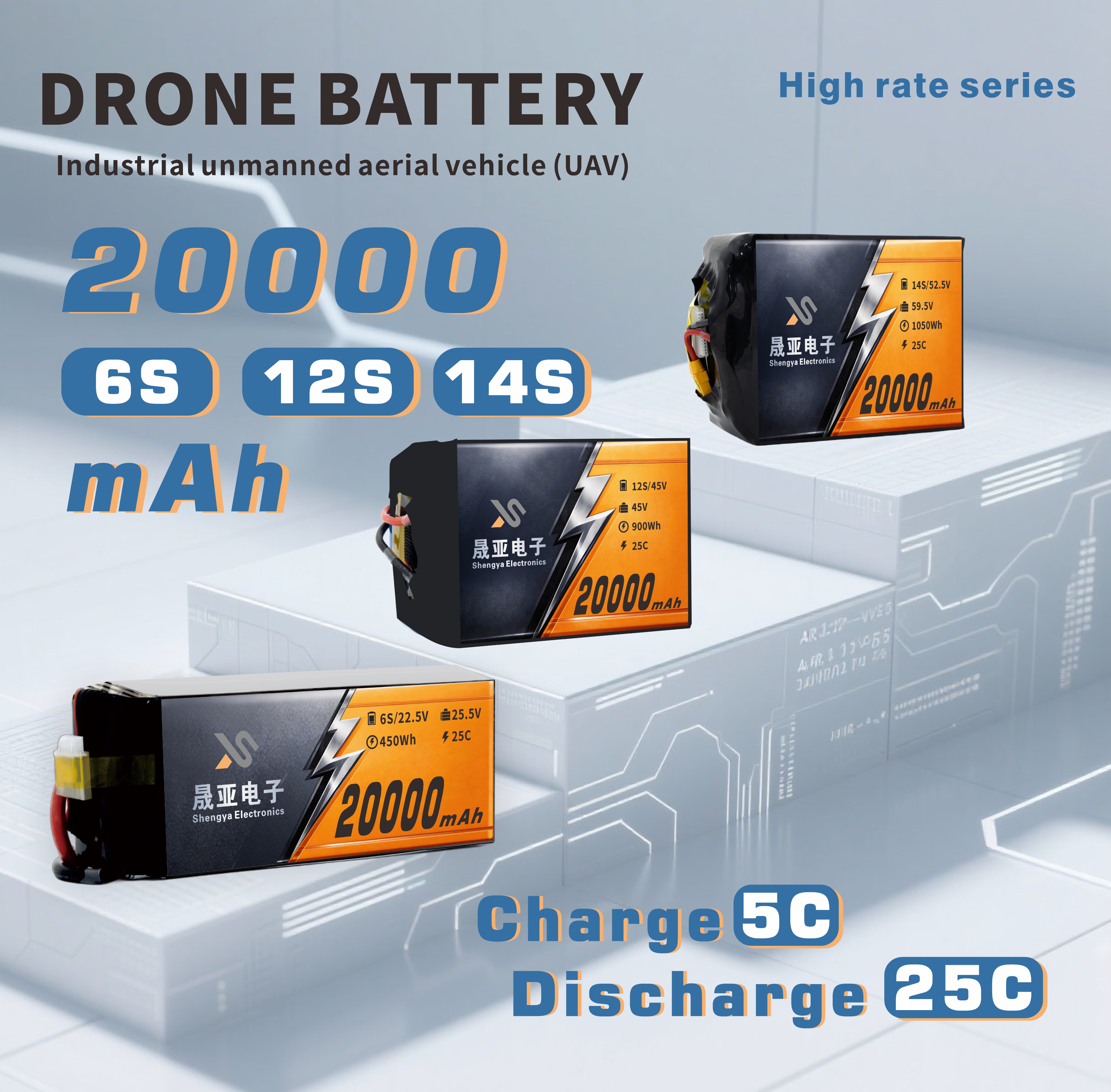
For commercial heavy-lift applications, utilizing a robust pack like the Shengya 20000mAh 25C provides a massive 500-amp continuous discharge capability. This specific configuration ensures that even under the most extreme agricultural or cinematic payloads, the battery remains cool and voltage stays stable.
Weight-to-Power Ratio Considerations
Finding the optimal weight-to-power ratio requires analyzing the thrust-to-weight ratio of your UAV. A general rule for standard multirotors is to maintain a minimum two-to-one thrust-to-weight ratio to ensure basic maneuverability, though higher ratios are preferred for industrial applications. When calculating your total takeoff weight, the battery often accounts for up to thirty percent of the mass. By carefully plotting the energy density against payload requirements, operators can maximize flight time without compromising aerial agility.
Evaluating Cell Manufacturers and Quality Control
Not all manufacturing processes yield the same results. Sourcing Reliable LiPo Battery Cells requires evaluating the quality assurance protocols of the fabricator. High-end suppliers provide precise nominal voltage options, such as 3.65V, 3.70V, or 3.75V base cells, and perform strict factory matching. This process involves testing thousands of individual units and grouping them into packs based on nearly identical internal resistance and voltage curves. If a multi-cell pack contains one unit with a significantly higher resistance than the rest, that single bottleneck will discharge faster, overheat, and cause the entire pack to fail prematurely.
From Single Cells to Custom UAV Battery Packs
Series and Parallel Configurations
Individual units are routinely assembled into complex packs to achieve specific voltage and capacity targets. Wiring in series increases total voltage, while wiring in parallel multiplies total capacity and maximum current output. For instance, a configuration featuring two parallel groups of six series-wired cells delivers substantial power. If each individual unit is 3.7V and 3000 milliampere-hours, the resulting pack delivers a nominal voltage of 22.2V and a robust capacity of 6000 milliampere-hours. This modular approach allows engineers to build custom form factors that precisely match the structural constraints of a drone.
The Role of the Battery Management System
Traditionally, hobbyist drone packs relied entirely on external balance chargers to manage cell health, omitting internal circuitry to save precious grams. Today, the landscape of enterprise aviation is rapidly shifting toward smart batteries. These intelligent packs incorporate a built-in Battery Management System that actively monitors individual voltages, regulates temperature, prevents over-discharging during flight, and automatically discharges the pack to a safe storage voltage when left unused. While this system adds slight weight, the resulting increase in safety is considered mandatory for modern commercial drone fleets.
Safety, Maintenance, and Charging Best Practices
Proper Balance Charging Techniques
Polymer chemistry is inherently volatile if mismanaged, making balance charging the most critical maintenance practice. During a discharge cycle, individual cells within a pack deplete at slightly different rates due to minute variances in internal resistance. Charging a pack without balancing means the charger only reads total voltage, potentially pushing one cell dangerously past peak voltage and triggering a violent chemical fire. A dedicated balance charger monitors and adjusts each cell individually, ensuring all units reach peak voltage simultaneously.
Safe Storage Voltages and Temperatures
Leaving a pack fully charged for more than a few days causes irreversible chemical stress, leading to capacity loss and physical swelling. Conversely, storing them fully depleted will permanently destroy the internal chemistry. The ideal storage voltage is strictly between 3.80V and 3.85V per cell. Environmental conditions also play a massive role in degradation. Power sources should be stored in a fireproof container in a cool, dry environment, ideally between fifteen and twenty-five degrees Celsius, away from direct sunlight or freezing temperatures.
Identifying Damaged or Puffed Cells
Routine physical and electrical inspections are fundamental to aviation maintenance. The most obvious warning sign of a failing unit is puffing, where the foil pouch swells like a balloon due to the generation of internal gases from electrolyte decomposition. This is usually the result of over-discharging, excessive heat, or physical trauma. Look at the telemetry data. If your balance charger reports a sudden spike in internal resistance, or if one cell consistently drops voltage faster than the others, the pack is structurally compromised and must be formally retired.
The Future of UAV Power: Industry Trends and Advancements
The relentless demand for longer flight times without increased weight is actively reshaping battery manufacturing. Market analysis indicates a massive industry push toward integrating silicon-graphene additives into the anode structure. Traditional graphite anodes have a strict theoretical capacity limit, but silicon can absorb significantly more lithium ions. By wrapping silicon in a graphene matrix, engineers can mitigate expansion issues, resulting in drastically higher capacities without increasing physical weight. This trend is heavily driven by the rapid expansion of electric vertical takeoff and landing aircraft and heavy-logistics platforms.
Simultaneously, the industry is aggressively pursuing solid-state battery technology. By replacing the flammable liquid or gel polymer electrolyte with a non-flammable solid material, solid-state cells promise to push energy densities well beyond current theoretical limits while completely eliminating the risk of thermal fires. As regulatory bodies enforce stricter safety standards for beyond-visual-line-of-sight flights, these material advancements will soon transition from experimental labs to standard commercial drone fleets.
Conclusion
High-quality energy components are the lifeblood of drone performance, providing the reliable power needed for safe and efficient flights. Understanding the nuances of discharge ratings, voltage curves, and capacity limitations might seem daunting, but carefully matching these specifications to your propulsion system is the key to unlocking true aerial potential.
As technology advances, operators must remain vigilant about maintenance, balance charging, and proper storage to protect their equipment. Always evaluate your power setups before every mission and consult with industry experts to find the most appropriate energy solutions. By investing in premium, well-matched components, you ensure not only the operational success of your current flight but the long-term safety of your entire fleet. For engineers and operators looking to source industry-leading power solutions, visit Shengya Power at https://www.shengyapower.com to explore a full range of high-performance aviation battery cells tailored to your exact specifications.
FAQ
What is the lifespan of typical drone power cells?
Most high-power drone batteries last between 150 to 300 charge cycles. This lifespan heavily depends on how aggressively they are discharged, the quality of routine maintenance, and storage conditions. Deeply discharging a battery below 3.2V per cell or storing it fully charged at elevated temperatures will drastically reduce its cycle life. With strict adherence to storage voltages and conservative flight times, operators can maximize the longevity of their investment.
Can I mix different brands of cells to build a custom pack?
No. Mixing different brands, capacities, or ages of battery cells is highly dangerous. Cells within a single pack must be perfectly matched in internal resistance, capacity, and discharge curves. If unmatched units are wired together, the weaker cell will discharge faster, dropping below safe voltage thresholds while the overall pack voltage appears normal. This imbalance inevitably leads to localized overheating, severe degradation, and a high probability of a chemical fire.
What does a 100C rating mean for high-performance applications?
A 100C rating indicates that the battery can safely discharge its entire capacity continuously at a rate one hundred times its amp-hour rating. For a 1000 milliampere-hour battery, a 100C rating allows for a continuous draw of 100 amps. This extreme discharge capability is ideal for racing or heavy payload lifting, where sudden, massive bursts of energy are required to overcome inertia or execute rapid aerial maneuvers.
How do I safely dispose of damaged or unreliable packs?
Damaged cells must be fully discharged to zero volts to neutralize their chemical energy before disposal. This can be done using a specialized halogen bulb discharger or a low-current resistor. Once fully neutralized and showing zero volts on a multimeter, the battery is inert. It should then be dropped off at a certified battery recycling facility. Never puncture a pouch, and never throw lithium-based power sources into regular municipal trash, as they pose a severe fire hazard to waste management infrastructure.
Why are my battery pouches puffing up?
Puffing is caused by the generation of gas inside the sealed foil pouch due to the chemical decomposition of the internal electrolyte. This decomposition is typically triggered by operational abuse, such as over-discharging below safe limits, overcharging beyond peak voltage, excessive heat buildup during flight, or simply chemical degradation over time. Puffed cells have compromised internal structures, are no longer safe for flight operations, and should be safely discharged and retired immediately.
How do I calculate the exact battery size needed for my custom drone?
To calculate the correct battery size, you must first determine the total maximum current draw of all your motors combined at full throttle. Once you have this peak amperage, select a battery whose capacity and discharge rating multiplied together exceed this number by at least twenty percent. You must then weigh this battery against your drone thrust-to-weight ratio to ensure the added capacity does not make the aircraft too heavy to fly efficiently.
What causes severe voltage sag during flight?
Voltage sag occurs when the drone motors demand more electrical current than the battery is chemically capable of delivering at that specific moment. This is usually caused by using a battery with a discharge rating that is too low for the propulsion system, flying with an old battery that has high internal resistance, or operating the drone in extremely cold weather which slows down the internal chemical reactions.